# The Recorder
## Overview
The Sentiero recorder is a JavaScript module built on [rrweb](https://www.rrweb.io/). It captures DOM mutations and user interactions, compresses them with gzip, and sends batches to the server. This page covers the recorder's internal behavior: how events flow from capture to delivery, what happens on failure, and how configuration affects each stage.
For privacy controls, see [Privacy & Masking](/guide/privacy/). For custom event tracking, see [Custom Events](/guide/custom-events/).
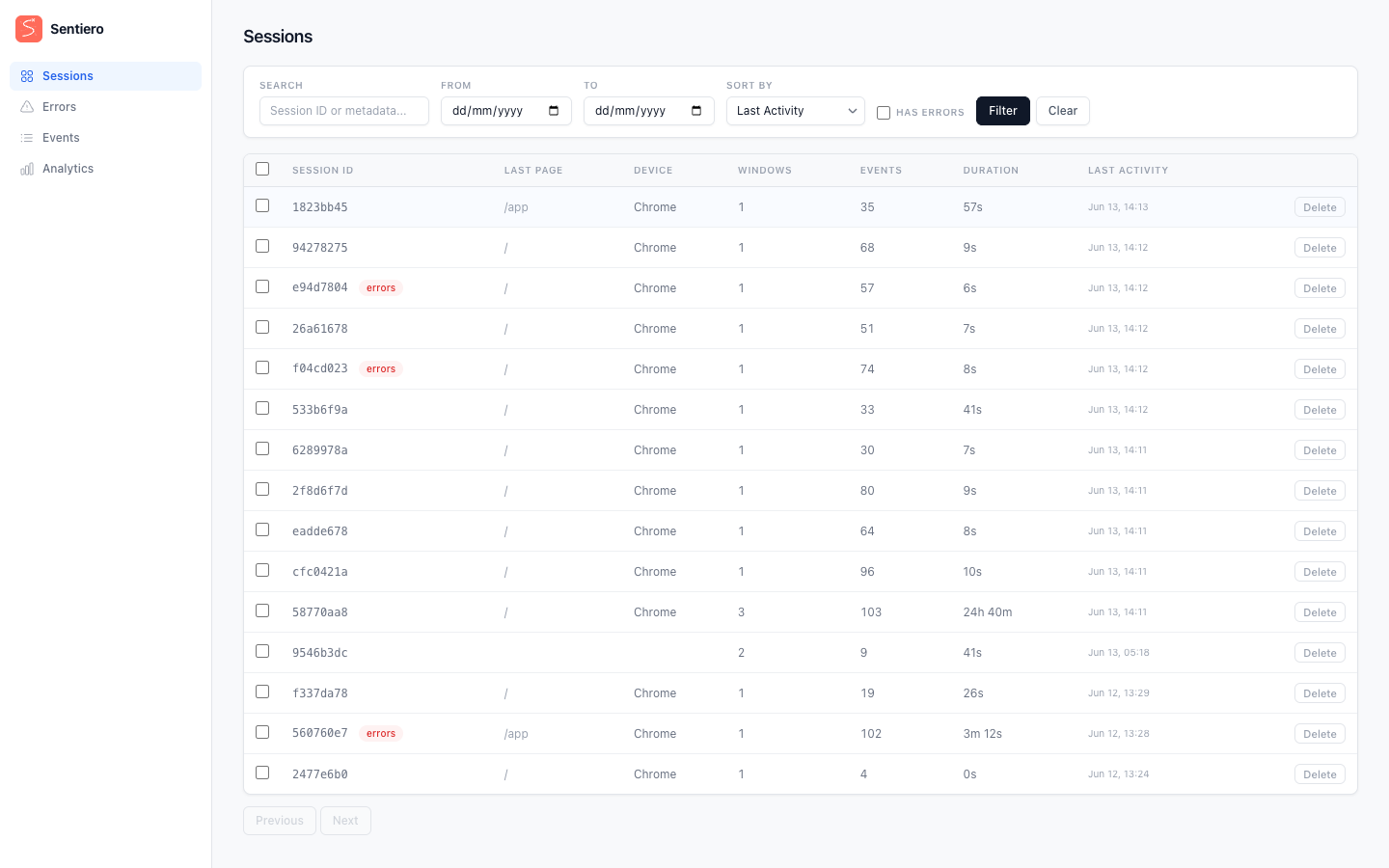
*Recorded sessions appear in the dashboard's session list, with per-session event counts, duration, and error badges.*
## How the Recorder Loads
The recorder is loaded via two elements injected by `Sentiero::Web::ScriptTag.render`:
```html
```
On load, the recorder:
1. Reads the JSON config element (`#sentiero-config`). If absent, falls back to deriving `eventsUrl` from the script's own URL.
2. Creates a `Transport` instance with flush settings and session IDs.
3. Starts rrweb recording with privacy defaults merged in.
4. Registers `visibilitychange` and `pagehide` listeners for page-close flushing.
5. Optionally enables error capture, navigation tracking, and custom event tracking based on config flags.
6. Starts the periodic flush timer.
If no config element is found and `eventsUrl` cannot be derived, recording is silently disabled.
## Batching Strategy
Events are buffered in memory and sent in batches. A batch is flushed when either 10 seconds have elapsed or the buffer accumulates 50 events, whichever comes first. Both thresholds are configurable.
| Trigger | Default | Config key |
|---------|---------|------------|
| Time elapsed since last flush | 10,000 ms | `flush_interval_ms` |
| Event count in buffer | 50 events | `flush_event_threshold` |
The time-based flush runs on a `setInterval`; the count-based flush triggers synchronously inside `addEvent`. A flush is skipped if another is already in progress or the backoff period has not elapsed.
## Page Hide / Unload
When the user navigates away or closes the tab, remaining buffered events are sent via `navigator.sendBeacon`. This is a best-effort mechanism; the browser may still drop the request.
Two events trigger beacon flush:
- `visibilitychange` when `document.visibilityState === "hidden"`
- `pagehide`
Beacon payloads are **not** gzip-compressed (unlike normal flushes). They are sent as plain JSON blobs.
If the payload exceeds 64,000 bytes the buffer is split in half; the first half is sent and the second is dropped. A single-event buffer that still exceeds the limit is abandoned entirely.
## Compression
Normal (non-page-close) flushes gzip-compress the JSON payload before sending, which substantially reduces payload size for typical DOM-heavy recordings.
The payload is JSON-stringified, encoded with `TextEncoder`, compressed with `gzipSync` ([fflate](https://github.com/101arrowz/fflate)), and sent via `fetch` with `Content-Encoding: gzip`. Beacon flushes skip compression because `sendBeacon` does not support custom headers.
## Retry with Exponential Backoff
When a flush fails, the events are re-queued and the transport backs off before retrying. After 10 consecutive failures the buffer is dropped to prevent unbounded growth.
On failure, events are re-queued at the front of the buffer and `_metadataSent` is reset so metadata is re-sent on the next successful flush. The backoff formula is `min(1000 * 2^(retryCount - 1), 30000)` ms, giving the sequence: 1s, 2s, 4s, 8s, 16s, 30s, 30s, 30s, 30s, 30s. On success, retry state is cleared.
## Buffer Overflow
The buffer is capped at 5,000 events. If the server is unreachable long enough for the buffer to fill, the oldest events are dropped to keep memory bounded. A console warning is logged when this happens.
## Session and Window ID Management
Sentiero uses two IDs to organize recordings:
| ID | Storage | Scope | Purpose |
|----|---------|-------|---------|
| Session ID | `localStorage` (default) or `sessionStorage` | User/browser | Groups all activity from one user |
| Window ID | `sessionStorage` | Tab | Distinguishes concurrent tabs within a session |
After recording starts, these IDs are also mirrored into two first-party cookies (`sentiero_sid` and `sentiero_wid`) so the server-side reporter can link server exceptions to the front-end replay. See [Browser Storage & Cookies](/guide/privacy/#browser-storage--cookies) in the Privacy guide for cookie details and EU consent implications.
### Cross-Tab Sessions
When `cross_tab_sessions` is `true` (the default), the session ID is stored in `localStorage`. All tabs in the same browser share the same session ID. This produces a unified recording of the user's journey across tabs.
When `cross_tab_sessions` is `false`, the session ID is stored in `sessionStorage`. Each tab gets an independent session ID. Tabs are not correlated.
The window ID always uses `sessionStorage` regardless of the `cross_tab_sessions` setting.
### ID Generation
IDs are generated with `crypto.randomUUID()` (UUID v4). If storage is unavailable (private browsing, storage quota exceeded), a per-page fallback is used: the ID is generated once and held in a module-scoped variable. It will not persist across page loads in this fallback mode.
## Configuration
Recorder behavior is driven by Ruby config options serialized into the JSON config element. See [Configuration](/guide/configuration/) for the full reference of flush, capture, and tracking options, and [Privacy & Masking](/guide/privacy/) for masking and other privacy-related rrweb options.
## Metadata Capture
When `capture_metadata` is enabled, the first flush includes a `metadata` field with:
| Field | Source |
|-------|--------|
| `url` | `window.location.href` |
| `referrer` | `document.referrer` |
| `userAgent` | `navigator.userAgent` |
| `viewport` | `${innerWidth}x${innerHeight}` |
Metadata is sent once on the first successful flush. If custom metadata is added via `window.Sentiero.setMetadata({...})`, updated values are included in subsequent flushes.
If a flush fails, `_metadataSent` is reset so metadata is re-sent on the next attempt.
## Error Capture
When `capture_errors` is enabled, the recorder listens for:
- **`error` events** capture `message`, `source`, `lineno`, `colno`, and `stack`. (`source` is the file URL from `event.filename`; the payload key is `source`, not `filename`.)
- **`unhandledrejection` events** capture the rejection `message` and `stack`.
Both are recorded as rrweb custom events with the tag `"error"`. They appear in the session timeline during replay. Error listeners are wrapped in try/catch to prevent infinite error loops if the recording itself throws.
For how these client-side errors surface in the dashboard and how server-side exceptions are linked to replays, see [Error Tracking](/guide/error-tracking/).
## Navigation Tracking
When `track_navigation` is enabled, the recorder listens for clicks on `` elements (capture phase) and records a custom event with tag `"navigation"` containing:
| Field | Value |
|-------|-------|
| `url` | The link's `href` |
| `text` | Link text content (truncated to 100 chars) |
| `external` | `true` if the link points to a different origin |
Skipped links: `javascript:` hrefs, bare `#` anchors, same-page hash links.
## Transport Lifecycle
```
init() -> readConfig() -> new Transport() -> record({emit: ...}) -> transport.start()
|
addEvent(event)
|
buffer.push -> overflow check -> threshold check
|
flush() [fetch + gzip]
|
success: reset retry
failure: re-queue + backoff
|
[page hide] -> flushBeacon() [sendBeacon, no gzip]
```